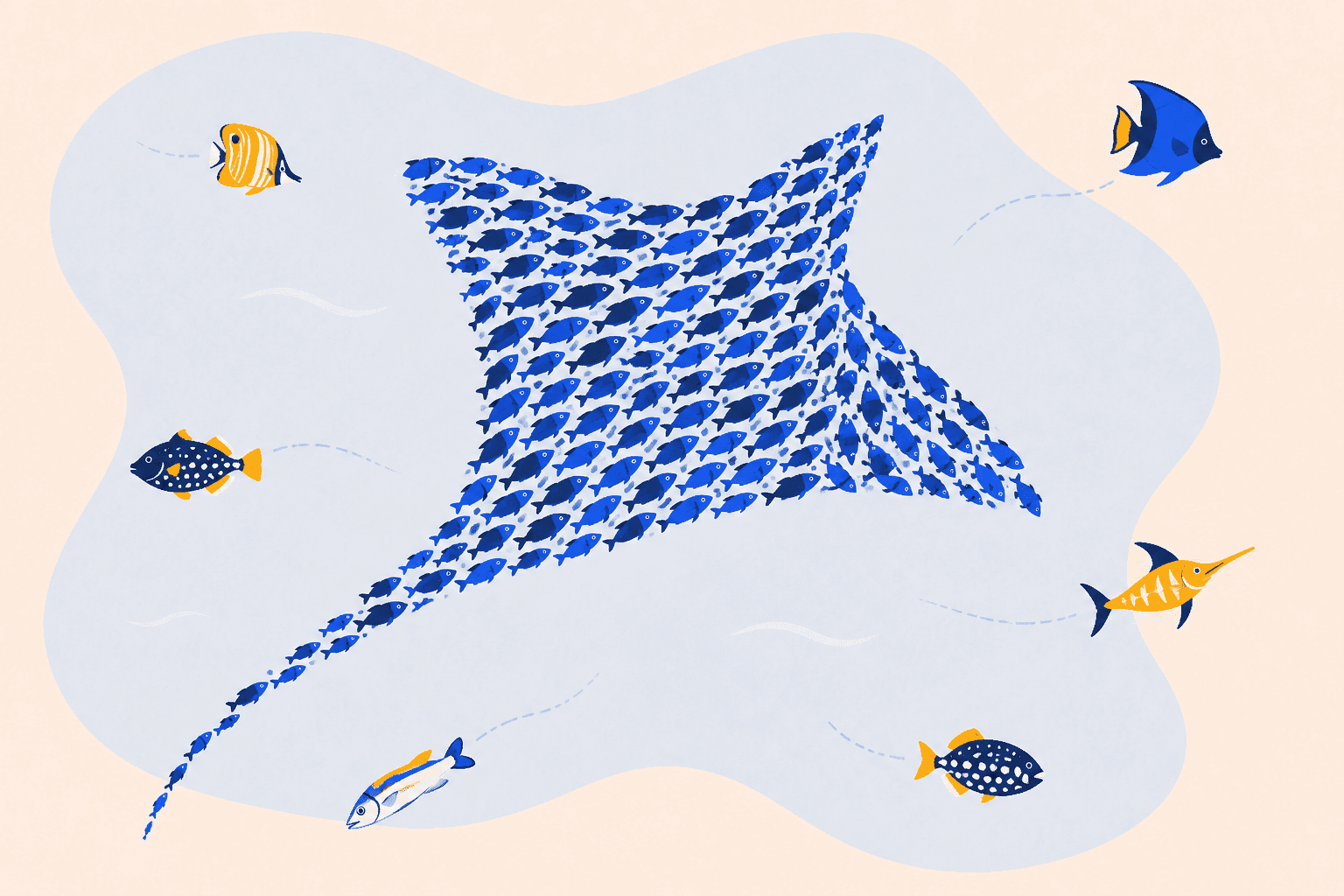
The Board of Innovation's Stingray model is an attempt to rethink the Double Diamond, the UK Design Council's four-stage design process (Discover, Define, Develop, Deliver), for an AI-assisted world.
Teams feed AI real business, market and customer evidence. They then use it alongside human input to generate, group and develop ideas at a scale that the Board of Innovation says no human-only workshop could match.
Most of this makes sense to me. AI is very good at generating ideas.
In one study of AI- and human-generated product ideas, AI ideas were seven times more likely than human ideas to make the top 10%. The researchers ranked them by purchase intent: how likely people said they were to buy the product.
That is not a small improvement. If the goal is producing promising concepts quickly, the study suggests AI is better at it than people are.
AI-generated ideas cover less ground
The part of Stingray I question is the claim that this exploration can be "exhaustive." Volume isn't the same as range: a good discovery process depends on diverse ideas, not just a large number of them.
The same product study found that AI-generated ideas were less novel on average and more similar to one another. Showing the model examples of successful ideas made that similarity even worse.
A separate study by Meincke, Nave and Terwiesch found the same tension from a different angle. People were asked to invent a toy using a paper bag, a brick and a fan. The researchers measured how many ideas were genuinely distinct from every other idea submitted. They found that 100% of the unaided human ideas were distinct from one another. That fell to 41.2% when people used ChatGPT, and 6% when ChatGPT generated the ideas on its own.
The AI-assisted ideas were stronger individually. Collectively, they covered less ground.
That is the distinction I think Stingray misses. Volume is not the same as range. A model can generate hundreds of plausible concepts without exploring many genuinely different directions.
Building more range into AI ideation
This has changed how we run AI-assisted ideation sessions. For example, it's clearly important not to treat one model as if it were a crowd. In my opinion a broader session should:
let people form ideas independently before seeing AI output
use more than one model or information source, not just more prompts on a single one
keep those streams separate during early exploration
combine and cluster the ideas later
assess how much territory the ideas cover, not just how many were produced
At PaperKite, we already use AI during ideation. We shape what it sees through deliberate framing, varied prompts and real customer evidence when we have it. For very early-stage ideas, we use AI to form hypotheses about customer problems, often through a jobs-to-be-done lens. We then validate those hypotheses through UX research. Once the problem is clearer, we use AI again to explore possible solutions, including technical ones.
We're still experimenting with this in real Discovery engagements, refining our practice as we go.
If you use AI in ideation, I'd love to hear what you're doing to create genuinely different directions, not just more ideas within the same one.
Let’s keep learning, together