When Coke asked us to fix payments, we found something much, much bigger
Nic Gibbens
-
25 Mar 2026
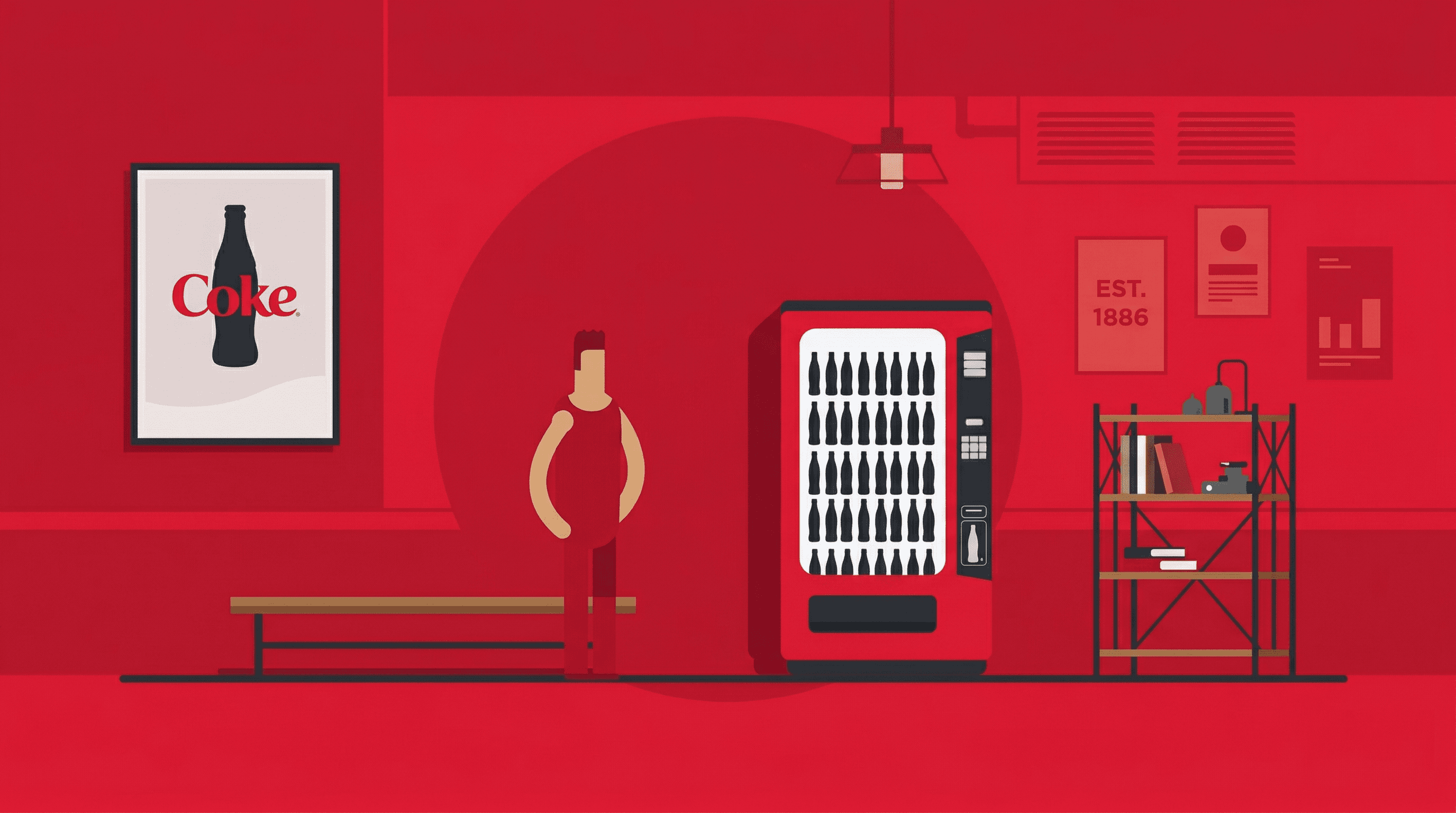
I was telling this story to a new member of the team the other day, and halfway through I realised why it’s stuck with me for almost a decade. It’s not just a good tale about vending machines and ultrasonic sound waves (though it is that). It’s the clearest example I have of what happens when you resist the urge to solve the obvious problem and instead ask: what’s the potential here to solve even bigger problems and create a better digital experience for the end user?
Back in 2016, we had our first conversation with Coca-Cola about what seemed like a straightforward challenge. People weren’t using their vending machines like they used to. The reason was simple enough: nobody carried cash anymore, and cash was the only way to use the machines. They’d explored NFC payments but found it wasn’t as straightforward as they’d hoped. So they came to PaperKite, and we ended up working closely with them for the next seven years.
Now, we could have just built them a payment app. Job done, invoice sent. But we saw something bigger: an opportunity to discover what a better digital experience could look like for the end customer, and in turn what could be a better opportunity for Coke themselves.
The call for help
As we started talking to their team, we discovered something that changed everything. These vending machines, sophisticated pieces of hardware sitting in train stations, shopping centres, and office buildings across the country, had exactly one way of communicating with the outside world. A single signal: “Help!”
That call could mean I’m jammed. It could mean I’m out of stock. It could mean I’m on the back of someone’s truck being stolen. The signal didn’t say. So an engineer would climb into a van, drive out to the location, open up the machine, figure out what was actually wrong, and hopefully fix it on the spot. Potentially they may even need to head back to base to get the right parts, and then back to the machine again.
When Coke told us they were planning to rebuild the machines with smarter connectivity anyway, we saw the opening. If you’re going to make these machines talk, why limit the conversation to payments?
A goldmine hiding in plain sight
Here’s something that surprised us: vending machines were one of the only direct-to-consumer channels Coca-Cola had. When we stopped to think about it, it made sense. The vast majority of their products are sold through supermarkets, dairies, cafes and restaurants. All third parties. The vending machine was one of the few places where Coke owned the entire journey from product to consumer.
And yet they were getting almost no useful data from it.
At the time, they were launching a new product called Coca-Cola Life. The traditional approach to understanding how it was landing in market involved hiring a research company to send attractive people down to Britomart train station to thrust free bottles into commuters’ hands. A month later, they’d go back and try to find those same people to ask if they’d enjoyed it, if they’d buy it again, if they’d choose it over their usual drink.
It worked, sort of. But the sample sizes were small, the data was patchy, and the whole thing was expensive and unpredictable.
We realised that an app with a wallet, letting users load money or link a card, changed everything. We could push a message to every user: “We’ve got something new we think you’ll love. Here’s a free one at your nearest machine.” Then we’d know who redeemed it and who didn’t. We could send reminders. A week later, we could ask what they thought. We could offer them another one. We could see if they started choosing it over their regular drink.
Suddenly Coke had a direct line to real behavioural data at a scale and specificity they’d never had before.
And then it got fun
Once you have a wallet and purchase history, ideas start flowing. We built a loyalty program where you buy enough drinks and earn a free one. We enabled marketing offers that Coke had never been able to test before: buy-one-get-one, time-based discounts, product trials.
One of my favourites was the “King or Queen of the Machine.” For machines with digital displays, common in offices and train stations, whoever bought the most drinks in a month got to name the machine. There were some checks on language, obviously. But watching people compete for bragging rights on a vending machine in their office was genuinely delightful.
We explored the idea of tying it all back to Coke’s “Share the Happiness” positioning. What if you could gift a drink to a friend? What if you could gift one to a stranger at a random machine across the city? We even sketched out a version where someone in Wellington could send a drink to a random person in Nairobi, with a prompt to share the moment on social media. That particular vision never made it to production, but it showed what was possible when you let the thinking breathe.
Smarter trucks, happier customers
The inventory data opened up another angle entirely. On a hot Sydney day, the machines at the front entrance of a Westfield would empty out far faster than the ones tucked away inside. Previously, that meant trucks running back and forth all day to restock the busy machines, while the others sat mostly full.
With connected machines and an app that knew where users were, we could nudge customers toward the less-depleted machines with small incentives like a discount or a credit for next time. Balance the load across machines, and suddenly one truck run restocks everything. Lower costs for Coke, fewer trucks on the road meaning less traffic and less pollution, and customers who actually find their favourite drink in stock.
The bit that still makes me smile
We needed to solve a practical problem: if you’re pre-ordering drinks on your phone, how does the machine know you’re the one standing in front of it and not the person behind you?
Our solution was ultrasonic sound. Each machine emitted a unique audio signature that smartphones could detect but humans couldn’t hear. When you reached the front of the queue, your phone recognised it was in front of the correct machine and prompted you to hit “Vend” to collect your drinks.
As far as we know, this was the first of its kind.
The real lesson
Coke came to us to solve a payment problem. What they got was a platform that transformed how they understood their customers, tested new products, managed inventory, and engaged with their market.
That happened because we have a proven discovery methodology that creates space for these discoveries. One-to-one conversations with the people who actually understand the business and its customers, combined with a team who knows what the technology is capable of. That’s where the magic happens.
Clients often come to us expecting technical limitations that don’t actually exist. They’re focused on the immediate problem, which makes sense because that’s what’s hurting. But when you take the time to dig deeper, opportunities multiply.
We’ve been doing this for nearly 16 years now, across all kinds of industries and challenges. The technology changes, the problems change, but the approach stays the same: It’s our job to build the product our clients and their customers need, not necessarily the one they initially thought they wanted.
If that sounds like a conversation worth having for your business, we’d love to hear from you.
Let's create something ultrasonic together!